

Evaluating the Grid Storage Advantages of AOKLY GROUP as an Experienced Industrial Battery Manufacturer
The operational demands of localized grid networks dictate strict requirements for secondary power systems, focusing primarily on long-term reliability and predictable cost structures. Industrial facilities and regional substations depend heavily on stationary storage units that can absorb local generation spikes or supply energy during brief transmission dropouts. In this context, an industrial battery manufacturer must optimize electrode structures and grid alloys to ensure sustained performance over multi-year cycles. AOKLY GROUP utilizes its decades of manufacturing experience to deliver deep-cycle and standby configurations that directly support these critical local grid functions.
1.Technical Characteristics and Storage Adaptability
Stationary energy storage and industrial backup systems require specific mechanical and electrochemical attributes to function effectively within constrained environments. An examination of the technical portfolio from Guangdong Aokly Group Co., Ltd. reveals several engineering choices tailored for dense equipment racks and substation environments. The core design centers on the valve-regulated sealed maintenance-free structure, which utilizes an oxygen recombination cycle to eliminate the need for regular watering.
1.1 Gas Recombination Efficiency and Dense Rack Layout
The internal gas recombination efficiency exceeds ninety-nine percent under normal operating conditions. This mechanism prevents water loss and eliminates the risk of acid leakage or corrosive mist emissions. Consequently, facility operators can install these units in dense vertical rack configurations without providing extensive spacing for liquid maintenance or heavy acid ventilation hoods. This space-saving attribute assists localized grid sub-stations where real estate remains limited.
2.2 Flexible Voltage Configurations and Capacity Planning
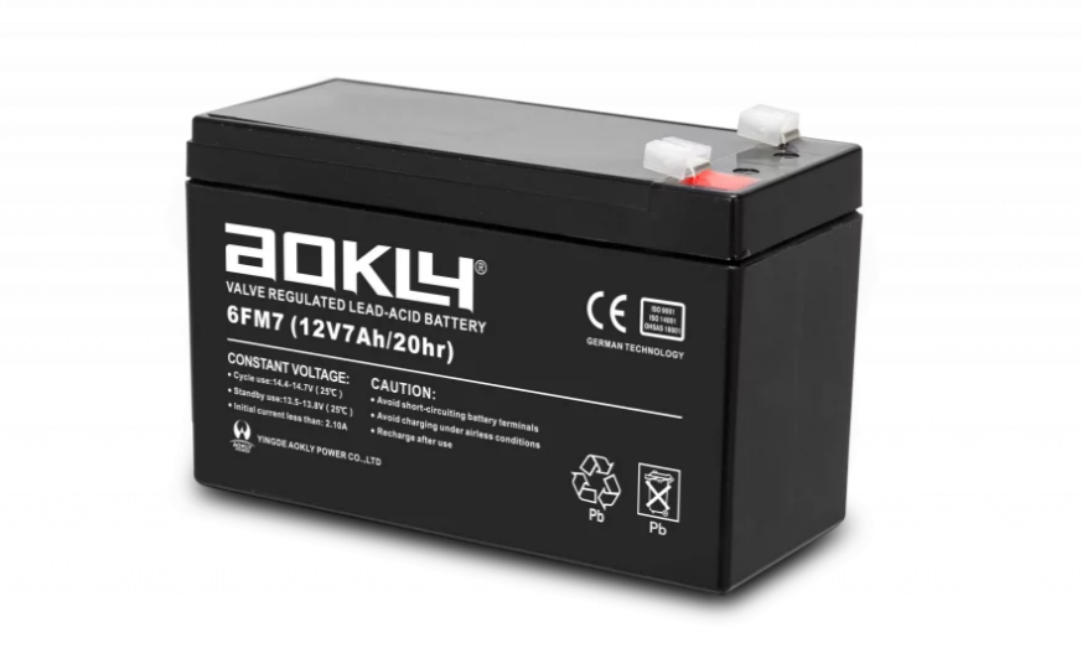
The availability of specific voltage form factors allows tailored system designs. The portfolio includes twelve-volt blocks for standard uninterruptible power supply (UPS) systems and small-capacity storage, alongside two-volt individual cells. The two-volt cells permit flexible series and parallel connections to assemble large-capacity stationary battery banks. These configurations commonly populate utility-scale direct current panels and large-scale data center backup rooms. The physical layout of these two-volt cells supports high-current discharge requirements and optimizes thermal dissipation across large installations.
3.3 Extended Lifespan via Alloy and Plate Optimization
Specialized grid alloy composition and paste density extend the service life during deep discharge cycles and prolonged float operations. The VRLA equipment designs incorporate thick positive plates and optimized lead-calcium-tin alloys to resist grid corrosion. This specific material composition reduces self-discharge rates and prevents early capacity loss under continuous float voltage conditions, ensuring readiness during unexpected grid anomalies.
2.Safety and Reliability Assessment
The intrinsic safety profile of a storage technology represents a primary consideration for indoor industrial deployments and sub-station integration. Unlike newer, highly reactive chemical pairs, VRLA technology exhibits low thermal runaway risks due to its aqueous electrolyte and stable lead chemistry. This stability makes an industrial battery suitable for installations adjacent to sensitive electronic instrumentation.
Guangdong Aokly Group Co., Ltd. uses specialized production equipment and testing protocols imported from Italy to maintain consistent manufacturing standards across large production lots. Automated machinery controls pasting density, plate alignment, and acid filling. Following assembly, each unit undergoes comprehensive testing for capacity verification, container airtightness, and internal resistance.
Maintaining strict consistency in internal resistance proves vital when constructing large series-connected strings for grid storage. A single defective cell with anomalous internal resistance can degrade the performance of an entire high-voltage bank, leading to premature system shutdown. By implementing automated multi-parameter testing, the manufacturer reduces cell variance within production batches. The use of flame-retardant acrylonitrile butadiene styrene (ABS) plastics for the battery casings provides additional physical containment and protection against external ignition sources, fulfilling standard industrial safety codes.
3.Empirical Application Scenarios
The operational utility of these VRLA systems manifests across several distinct stationary applications where continuous voltage stability takes precedence over energy density. In standard uninterruptible power supply frameworks, these battery banks provide immediate bridging energy during the critical interval between a primary grid failure and the activation of auxiliary diesel generators.
In telecommunications infrastructure and modern data center direct current backup systems, AOKLY GROUP systems provide stable voltage regulation. These sites require immediate, high-rate power delivery to prevent data corruption during switching events. Furthermore, small-scale solar and wind generation stations use these stationary arrays as local direct current buffers. The arrays absorb rapid fluctuations from renewable inputs before the energy reaches the primary distribution inverters, smoothing the local power profile.
Selecting an appropriate configuration depends on analyzing specific load curves, required runtime durations, operational voltage thresholds, and ampere-hour capacities. Matching these variables prevents under-sizing, which accelerates plate degradation, or over-sizing, which increases capital expenditure. Tailored selection ensures that the chosen unit operates within its ideal depth of discharge parameters, preserving predictable service lifespans across diverse industrial sites.
4.Conclusion
As localized power networks require dependable infrastructure, the value of mature, maintenance-free battery storage becomes increasingly clear. Evaluating the grid storage options reveals that success in stationary deployment depends heavily on consistent manufacturing standards, flexible cell sizing, and robust mechanical safety design. AOKLY GROUP provides a practical approach to energy storage by focusing on refined VRLA technology that requires minimal operational oversight.
Rather than supplying unintegrated components, Guangdong Aokly Group Co., Ltd. emphasizes predictable service life and complete configuration compatibility for diverse industrial frameworks. For operators seeking reliable backup power and localized grid stability, utilizing established chemical technologies from a dedicated industrial battery manufacturer offers a stable, low-risk pathway toward maintaining continuous electrical operations.
For further information regarding product specifications and storage solutions, please visit the official website: https://www.aokly-battery.com/
FAQs
Q1: What are the main benefits of using VRLA batteries for grid-scale and industrial backup storage compared to lithium options?
A: While lithium batteries offer higher energy density, VRLA (Valve-Regulated Lead-Acid) systems from an experienced industrial battery manufacturer provide a highly stable, low-risk chemical profile with virtually zero thermal runaway dangers under normal operating parameters. VRLA technology does not require complex electronic Battery Management Systems (BMS) or active thermal cooling infrastructure. This mechanical simplicity significantly lowers initial capital expenditures and simplifies installation in remote grid substations or dense indoor server rooms where active fire risks are highly restricted.
Q2: Can AOKLY GROUP VRLA batteries be mounted horizontally or in tight enclosure spaces?
A: Yes. Because VRLA batteries utilize advanced gas recombination technology (achieving over 99% internal efficiency) and immobilize electrolyte within AGM separators or silica gel structures, there is no free liquid acid inside the casing. This leak-proof design allows these batteries to be safely positioned in tight, vertical rack enclosures and space-constrained battery cabinets without the hazard of acid leakage. This maximizes space utilization in data center battery rooms and localized microgrid cabins.
Q3: What is the typical float service life of industrial battery cells from Guangdong Aokly Group Co., Ltd.?
A: Under optimal temperature conditions of approximately 25°C (77°F) and standard float charge protocols, AOKLY GROUP 2V individual cells commonly deliver a design life of 15 to 20 years, whereas 12V block batteries are typically rated for 10 to 12 years. Actual lifespan depends directly on average operating temperatures, depth of discharge (DoD) profiles, and the implementation of stable charging voltages to prevent plate sulfation.
Q4: How does Italian automated production equipment improve the reliability of these battery banks?
A: In high-voltage grid storage systems where dozens of batteries are connected in series, the reliability of the entire system is dictated by the weakest cell. Automated plate-pasting and acid-filling machinery imported from Italy ensures that each battery produced has near-identical internal resistance, active material weight, and physical plate alignment. This high level of consistency prevents individual cells from being overcharged or undercharged in a string, preventing premature bank failure.
Q5: Are there flame-retardant options available for high-risk indoor backup systems?
A: Yes. For deployments in highly sensitive environments like hospital UPS setups, public utility switchgear rooms, or corporate data centers, Guangdong Aokly Group Co., Ltd. supplies industrial battery units built with UL94-V0 rated flame-retardant ABS (Acrylonitrile Butadiene Styrene) plastic casings. These containers offer robust structural support and prevent the spread of external combustion, satisfying strict municipal and industrial safety codes.
Guangdong Aokly Group Co.,Ltd
Guangdong Aokly Group Co.,Ltd
+862086861998 ext.
email us here
Visit us on social media:
LinkedIn
Instagram
Facebook
YouTube
TikTok
X
Legal Disclaimer:
EIN Presswire provides this news content "as is" without warranty of any kind. We do not accept any responsibility or liability for the accuracy, content, images, videos, licenses, completeness, legality, or reliability of the information contained in this article. If you have any complaints or copyright issues related to this article, kindly contact the author above.
