

Railroads Market to Reach USD 417.0 Billion by 2035, Growing at 4.9% CAGR
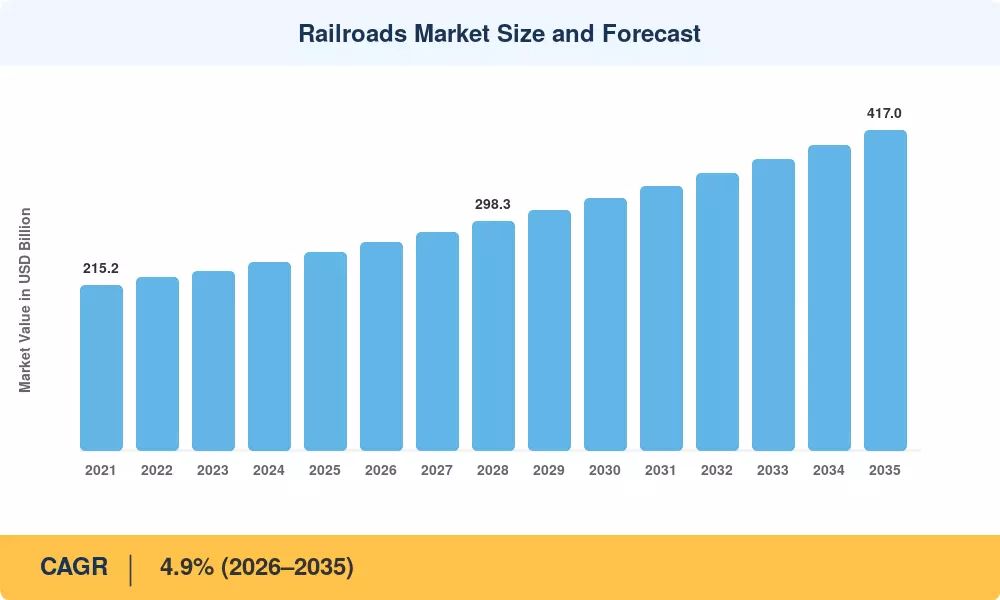
Railroads Market
Europe is forecast to grow at a 4.5% CAGR as the Fourth Railway Package standardizes cross-border operations.
NEW YORK, NY, UNITED STATES, August 31, 2026 /EINPresswire.com/ -- According to Market Research Future, the Railroads Market is projected to reach USD 417.0 Billion, at a CAGR of 4.9% during 2026 to 2035, driven by Integration of advanced automation and digital technologies in the Railroads Market enhances operational efficiency and safety. This steady growth reflects the global resurgence of rail transportation as governments and industries increasingly recognize its cost-effectiveness, environmental advantages, and capacity to address growing mobility and freight demands .Market Overview
Railroads represent a fundamental pillar of global transportation infrastructure, encompassing freight rail, passenger rail, and urban transit systems that move billions of tons of cargo and millions of passengers annually. The market includes rolling stock, infrastructure, signaling and train control systems, and operations and maintenance services that collectively ensure safe, efficient rail operations. As the industry undergoes digital transformation, railroads are becoming smarter, more connected, and increasingly automated, positioning rail as a preferred mode for sustainable long-haul transportation .
The key growth drivers propelling this market expansion include rising demand for rail freight transport, facilitating the movement of larger volumes of cargo over extensive distances at approximately one-tenth the cost of road transport . Governments worldwide are significantly investing in rail infrastructure, recognizing its cost-effectiveness and environmental benefits . The integration of digital technologies, including IoT, AI-powered analytics, and automated train control systems, is enhancing operational efficiency and safety across rail networks . The focus on sustainable transportation and modal shift from road to rail, driven by climate policies and carbon reduction targets, is accelerating infrastructure modernization and network expansion .
Technological developments are reshaping the railroad landscape at an accelerating pace. Digital signaling systems, including ETCS and CBTC, are replacing legacy analog systems, enabling real-time traffic management, increased line capacity, and enhanced safety . The adoption of predictive maintenance technologies using IoT sensors and AI analytics is reducing downtime and optimizing asset lifecycles . Electrification, hybrid, battery, and hydrogen propulsion solutions are advancing, supporting decarbonization goals and reducing dependency on diesel fuel . The Railway Signaling System Market is experiencing rapid growth as rail operators prioritize modernization of train control systems to enhance safety and capacity . Similarly, the Rail Infrastructure Market continues to expand as governments invest in new track construction, station upgrades, and comprehensive network modernization .
📍 Get Free Sample Report for Detailed Market Insights:
https://www.marketresearchfuture.com/sample_request/11998
Market Segmentation
The railroads market is segmented based on service type, component, and propulsion to provide comprehensive insights into the industry landscape.
By Service Type: The market is categorized into Freight Rail, Passenger Rail (Intercity), and Urban Transit & Metro. Freight rail dominates the market, accounting for approximately 80% of railroad revenue, essential for transporting diverse materials including gas, chemicals, crushed rocks, consumer goods, and vehicles . The growing reliance on rail routes for goods transport and lower transportation costs compared to alternatives is driving freight segment growth. Passenger rail represents a significant and growing segment as tourism expands, intercity travel demand increases, and governments invest in commuter rail networks . The growing tourist industry and low passenger train fares are expected to be main drivers of growth in the passenger rail segment in the coming years . Urban transit and metro systems are expanding rapidly in response to urbanization and congestion, with cities worldwide investing in new lines and system upgrades .
By Component: The market covers Rolling Stock, Infrastructure (Track & Civil Works), Signaling & Train Control, and Operations & Maintenance Services. Infrastructure, including tracks, bridges, tunnels, and stations, represents a substantial investment area as governments modernize aging networks and expand capacity . Signaling and train control systems are the fastest-growing component segment, driven by digitalization mandates, safety regulations, and interoperability requirements . Operations and maintenance services are expanding as rail operators adopt predictive maintenance and lifecycle asset management strategies .
By Propulsion: The market is segmented into Diesel-Powered, Electric-Powered, and Hybrid/Battery/Hydrogen solutions. Electric-powered rail dominates in regions with extensive electrification infrastructure, offering superior energy efficiency and lower emissions. Diesel-powered locomotives remain prevalent in freight and non-electrified corridors. Hybrid, battery, and hydrogen propulsion are emerging as sustainable alternatives for non-electrified routes, supporting decarbonization goals and reducing emissions .
By Region: The market analysis covers North America, Europe, South America, Asia Pacific, and the Middle East and Africa.
🛒 You can buy this market report at:
https://www.marketresearchfuture.com/checkout?currency=one_user-USD&report_id=11998
Regional Analysis
Asia Pacific represents the dominant and fastest-growing regional market for railroads, driven by massive infrastructure investments, rapid urbanization, and increasing industrialization across major economies . China leads the region with the world's largest high-speed rail network and extensive freight corridors, supported by state-backed infrastructure development. India is experiencing significant growth through railway modernization programs, including the development of the Bharat Train Control System for high-speed corridors and plans for nearly 7,000 km of future high-speed lines . Japan, South Korea, and Australia maintain advanced rail networks with continuous investment in digitalization and high-speed technology. Indonesia, the Philippines, and Vietnam are expanding urban transit systems to address congestion and improve mobility .
North America represents a mature and strategically important market, driven by federal investments in rail infrastructure, high-speed rail development, and freight network modernization. The United States is investing in passenger service upgrades and freight bottleneck removal through federal rail allocations . Canada's corridor improvements around Toronto-Montreal-Ottawa are driving demand for signaling retrofits and rolling stock upgrades . Strict Federal Railroad Administration compliance requirements maintain safety standards while favoring incumbents with certified systems . Mexico aligns Pacific port cargo lines toward United States gateways, leveraging trade agreements .
Europe holds a significant market share, shaped by stringent safety and interoperability regulations, the Trans-European Transport Network budget, and ambitious decarbonisation goals . Germany is investing billions through 2030 to boost freight capacity and finalize electrification, while France accelerates regional network upgrades . Eastern European members are modernizing Soviet-legacy tracks to align with EU standards. Interoperability regulations are driving mass ETCS procurement, standardizing demand across national networks . Climate taxation on aviation is nudging modal shift toward rail, indirectly enlarging revenue pools . The European rail signaling system market is poised for significant growth, driven by EU's push for interoperable, sustainable rail networks and accelerated investments in high-speed rail, smart mobility, and cross-border freight corridors .
South America and the Middle East and Africa represent developing markets with growing potential. Brazil leads South America with rail expansion to enhance connectivity and trade . The Middle East, particularly the UAE and Saudi Arabia, is investing in rail infrastructure as part of economic diversification and smart city development. South Africa leads the African market, with gradual adoption supported by improving infrastructure and economic conditions.
Competitive Landscape and Key Players
The railroads market is highly competitive, featuring a mix of state-owned enterprises, established rail operators, and technology providers. The competitive landscape is characterized by vertical integration, strategic partnerships, and technology innovation.
Key players operating in this market include Alstom SA, Siemens Mobility, Hitachi Rail Ltd., China Railway Corporation, Deutsche Bahn AG, Union Pacific Railroad Company, Canadian National Railway, and JSC Russian Railways Logistics . Chinese state-owned enterprises dominate large civil-works packages through scale economies and state-credit backing, led by China Railway Group and China Railway Construction Corp. . European firms Alstom and Siemens Mobility hold technology moats in signaling, rolling stock, and digital services, extending lifecycle contracts that elevate recurring revenues .
Strategic developments are reshaping the competitive landscape. Competitive strategy converges on vertical integration, with Alstom extending into predictive-maintenance software, bundling hardware and analytics . M&A activity continues, typified by Hitachi Rail's acquisition of a major signaling unit, sharpening end-to-end offerings . Regional capacity investments, such as Stadler's Eastern European factory, mitigate currency volatility and cut logistics costs . Cyber-resilience and low-carbon credentials are emerging as new tender differentiators, spurring R&D alliances across the value chain .
Innovation and technology initiatives are accelerating across the industry. Companies are investing in digital twin technologies, AI-powered predictive maintenance, and cloud-based signaling platforms that enable remote monitoring and real-time traffic management . The shift toward volume-based procurement models, such as Deutsche Bahn's USD 6.51 billion framework for digital control and safety technology, is creating long-term revenue visibility for suppliers and supporting standardized signaling platforms .
Latest Industry News and Developments
Recent industry developments highlight the dynamic nature of the railroads market. In March 2026, Alstom secured a signaling contract for the newly constructed high-speed tunnel in Poland as part of the Line 85 high-speed rail network, demonstrating ongoing demand for greenfield signaling deployment . In July 2026, Siemens Mobility secured a USD 352 million signaling modernization program in Romania, covering approximately 560 km of railway, 66 stations, 122 level crossings, and more than 2,000 signals, reflecting the scale of brownfield modernization across Europe .
In September 2025, Portalp Group launched Portalp Railway, a new venture focusing on platform screen doors, guided transport systems, and railway access control . In August 2025, Amtrak started preconstruction activities and awarded design-build contracts for three rail yard modernization projects along the Northeast Corridor to bolster service reliability . In June 2025, PORR secured a €428 million contract from Romania's National Railway Company to renovate and modernize the Craiova–Drobeta Turnu Severin–Caransebeș railway line .
In August 2025, Texmaco Rail & Engineering partnered with Rail Vikas Nigam Ltd in a joint venture to advance India's railway modernization and export competitiveness . In May 2026, Alstom signed a USD 344.7 million contract with Lausanne to modernize the m2 metro line with a new CBTC system combined with mid-life fleet modernization .
Market Challenges and Opportunities
The railroads market faces several key challenges that could impact growth trajectories. The industry is often perceived as traditional and mature, which can lead to resistance against embracing new technologies and digital solutions . The lack of interoperability among existing legacy systems complicates the integration of innovative tools . Cybersecurity concerns further exacerbate the situation, making stakeholders hesitant to adopt advanced technologies . High capital investment and long ROI cycles for signaling and infrastructure projects remain significant barriers, especially in large-scale or cross-border projects . Complex integration with legacy infrastructure, particularly in developed countries, and lengthy regulatory approvals add to project complexity . Skilled workforce shortages in automation, communications, and safety protocols constrain deployment capabilities .
Emerging opportunities are abundant in the evolving rail landscape. The shift toward digital and autonomous rail operations is creating demand for intelligent signaling integrated with data analytics, remote monitoring, and predictive maintenance . Growing demand for high-speed rail projects across Asia, Europe, and the Middle East is accelerating adoption of advanced signaling technologies such as ETCS and CBTC . Increasing urbanization and metro rail expansion, as cities become more congested, is driving demand for urban transit signaling and control systems . Regulatory mandates and international standards compliance are creating sustained demand for modern signaling solutions across both passenger and freight corridors . The development of high-speed rail corridors in India, with nearly 7,000 km of planned routes, represents a significant opportunity for train control technology, system integration, and lifecycle services .
Future growth potential remains steady, driven by the ongoing modernization of global rail networks, the shift toward sustainable transportation, and the increasing digitalization of rail operations. As governments prioritize rail infrastructure investment for economic development and decarbonisation, the railroads market will continue to expand, ensuring sustained innovation and growth throughout the forecast period.
To explore more market insights, visit us at:
https://www.marketresearchfuture.com/reports/railroads-market-11998
Final Market Summary
The railroads market is positioned for steady growth, driven by infrastructure investment, digital transformation, and the global shift toward sustainable transportation. The market's projected growth to USD 417.0 Billion by 2035 reflects the critical importance of rail transportation in supporting economic development, facilitating trade, and meeting mobility demands.
The long-term industry potential remains strong, with advancements in signaling technology, propulsion systems, and digital solutions continuing to expand the addressable market. The convergence of railroads with broader mobility ecosystems, including autonomous train operations, predictive maintenance platforms, and sustainable energy solutions, is creating comprehensive transportation solutions that serve diverse needs across freight, passenger, and urban transit segments.
Key factors expected to influence future development include the pace of digital signaling adoption, the evolution of regulatory frameworks, and the expansion of high-speed rail networks. The development of interoperable signaling standards and sustainable propulsion solutions will accelerate modernization and network integration. As rail becomes increasingly digital, automated, and sustainable, its role in the global transportation ecosystem will continue to expand, ensuring sustained growth and innovation throughout the forecast period and beyond.
More Related Reports from MRFR Library:
Automotive solenoid Market : https://www.marketresearchfuture.com/reports/automotive-solenoid-market-12251
Automotive Aluminum Extrusion Market : https://www.marketresearchfuture.com/reports/automotive-aluminum-extrusion-market-35499
Automotive Electric HVAC Compressor Market : https://www.marketresearchfuture.com/reports/automotive-electric-hvac-compressor-market-27800
Automotive Electric Fuel Pumps Market : https://www.marketresearchfuture.com/reports/automotive-electric-fuel-pumps-market-23950
Automotive Data Management Market : https://www.marketresearchfuture.com/reports/automotive-data-management-market-29972
Automotive Control Panel Market : https://www.marketresearchfuture.com/reports/automotive-control-panel-market-5314
Automotive Camshaft Market : https://www.marketresearchfuture.com/reports/automotive-camshaft-market-11576
Automotive Brake Linings Market : https://www.marketresearchfuture.com/reports/automotive-brake-linings-market-7690
Garbage Truck Market : https://www.marketresearchfuture.com/reports/garbage-truck-market-22481
Electric Motors Market : https://www.marketresearchfuture.com/reports/electric-motors-market-2376
Market Research Future
Market Research Future
+1 855-661-4441
email us here
Legal Disclaimer:
EIN Presswire provides this news content "as is" without warranty of any kind. We do not accept any responsibility or liability for the accuracy, content, images, videos, licenses, completeness, legality, or reliability of the information contained in this article. If you have any complaints or copyright issues related to this article, kindly contact the author above.
